Introduction
Image search techniques refer to structured approaches used to locate, verify, and analyze images across search engines and digital databases. These methods rely on keyword-based queries, reverse image lookup, metadata evaluation, and AI-driven visual recognition. As digital content continues to grow and AI-generated imagery becomes more common, understanding how image search systems work is no longer a niche technical skill. It has become a practical requirement for everyday digital work.
In 2026, visual content plays a central role in online discovery, verification, and decision-making. Images are used to communicate news, sell products, support research, and shape public perception. As a result, the ability to search and verify images accurately is directly tied to digital trust, credibility, and performance.
Across industries, professionals use image search techniques to verify authenticity, trace original sources, monitor brand assets, and improve visual SEO performance. Researchers rely on them to validate evidence, while marketers use them to improve content visibility and discoverability. These techniques reduce misinformation risks and improve search accuracy. A solid understanding of how image search works allows users to move beyond basic searching and apply reliable, defensible retrieval strategies.
What Are Image Search Techniques?
Image search techniques are structured methods used to locate, verify, and analyze images across search engines and digital databases.
They typically rely on:
-
Text-based queries
-
Embedded metadata
-
Visual similarity analysis
-
AI-powered image recognition
These techniques help users:
-
Find relevant images
-
Confirm authenticity
-
Identify original sources
They are widely used in:
-
Research
-
Journalism
-
Marketing
-
Compliance
-
eCommerce
For example, a journalist verifying a viral photo may use reverse image search to confirm when and where it first appeared, while a marketer may analyze how branded visuals appear across different websites. Modern image search systems combine metadata indexing with computer vision models to deliver accurate results at scale.
There’s plenty more to explore check out our other posts!
Definition and Core Concepts
Image search techniques retrieve and compare images by analyzing text queries, visual features, or embedded metadata stored in indexed image databases.
Key concepts include:
-
Queries can be keyword-based or image-based
-
Search engines analyze metadata, surrounding context, and pixel-level features
-
Results are ranked based on relevance, authority, and contextual signals
-
Retrieval may focus on exact matches or visual similarity
Types of Image Search Methods
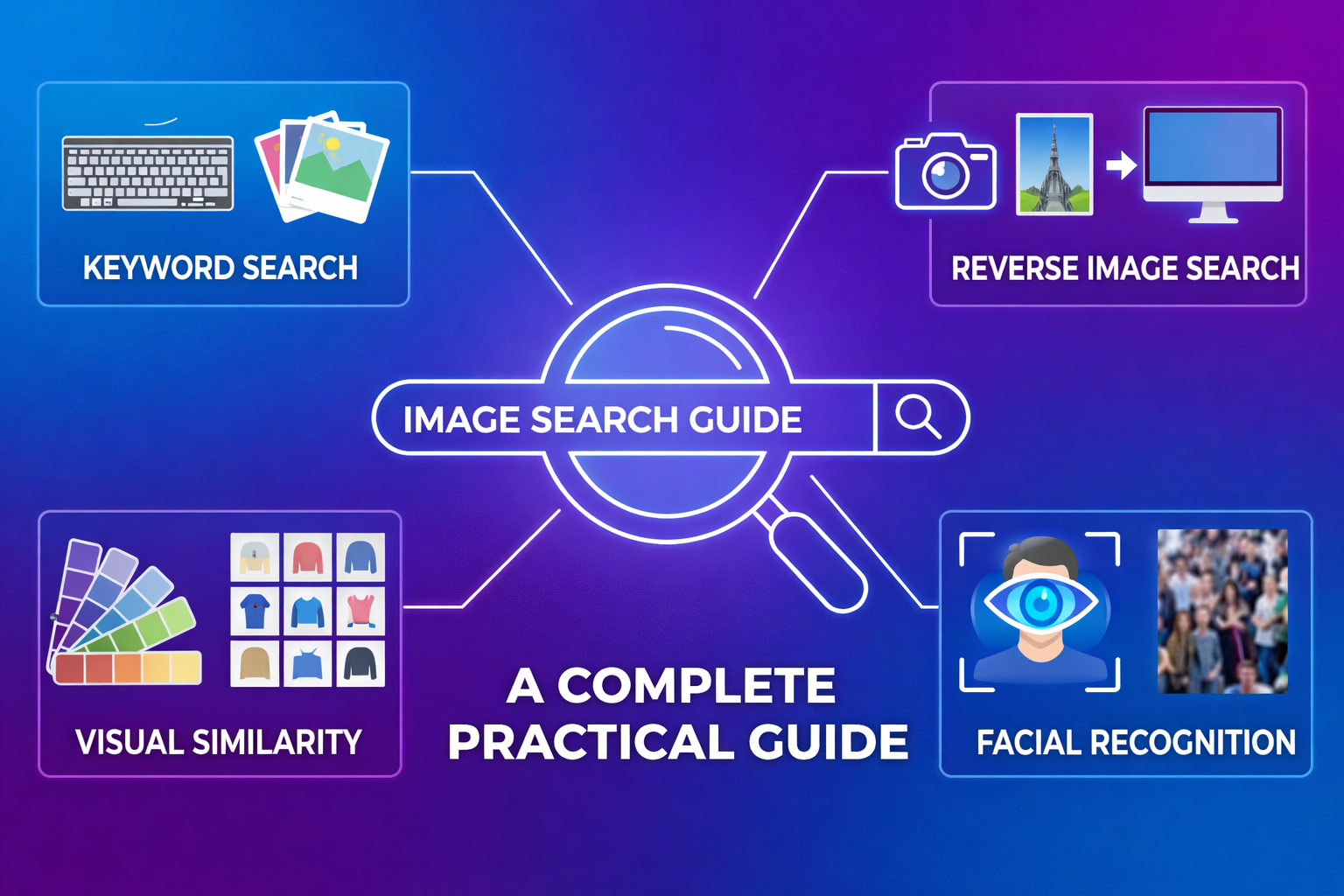
Image search methods generally fall into three primary categories: keyword-based search, reverse image search, and AI-powered visual search.
- Keyword-based search: Uses descriptive text to retrieve indexed images
-
Reverse image search: Uses an uploaded image as the query input
-
Content-based retrieval: Analyzes visual features such as shapes, textures, and colors
-
Metadata search: Filters images using tags, camera data, or usage rights
How Image Search Has Evolved with AI
Modern image search increasingly relies on machine learning models rather than only filenames or alt text.
Advancements include:
-
Neural networks interpreting objects, scenes, and patterns
-
Semantic understanding beyond surface-level visuals
-
Improved matching even when metadata is missing or incomplete
-
Visual embeddings enabling large-scale similarity search
While AI improves accuracy and scale, it is not flawless. Visual similarity does not always guarantee contextual correctness, and results may vary depending on training data and image quality.
How Image Search Works Behind the Scenes
Image search systems index both visual and contextual data, then match it against user queries.
The process typically includes:
-
Crawlers collecting images and related metadata
-
Algorithms analyzing pixel data and contextual signals
-
Indexes storing metadata and feature vectors
-
Ranking systems selecting the most relevant results
Metadata-Based Indexing
Metadata-based indexing matches images using text-related attributes such as:
-
File names
-
Alt attributes
-
Page titles and captions
-
Surrounding on-page content
Search engines connect this information to user queries using text relevance and ranking models.
Content-Based Image Retrieval (CBIR)
Content-Based Image Retrieval focuses on visual similarity rather than textual description.
This approach:
-
Extracts color histograms, shapes, and texture patterns
-
Converts visual data into numeric feature vectors
-
Compares vectors against indexed images
-
Returns visually similar results
CBIR is especially useful when metadata is weak, missing, or unreliable.
Machine Learning and Visual Recognition Models
Machine learning models play a central role in interpreting image content.
They:
-
Use convolutional neural networks to detect objects
-
Identify faces, landmarks, products, and environments
-
Improve accuracy through continuous training feedback
-
Enable contextual understanding beyond basic classification
These models support both similarity search and object detection at scale.
Image Ranking Factors in Search Engines
Image ranking depends on multiple factors, not visuals alone.
Common ranking signals include:
-
Page authority and domain trust
-
Contextual relevance of surrounding text
-
Image quality and resolution
-
Structured data and accurate alt text
-
User interaction and engagement metrics
Keyword-Based Image Search Explained
Keyword-based image search retrieves images using descriptive search terms.
In this method:
-
Text queries are matched to image metadata
-
Context and user intent influence ranking
-
Specific queries typically produce more relevant results
Despite advances in AI, keyword-based search remains the most widely used approach globally.
Using Descriptive Search Queries Effectively
Clear, descriptive queries significantly improve precision.
Best practices include:
-
Using specific nouns instead of generic terms
-
Adding modifiers such as location, timeframe, or style
-
Avoiding vague or overly broad phrases
-
Including context words like “diagram” or “infographic”
Clear input consistently leads to higher-quality results.
Advanced Search Operators for Images
Search operators allow users to refine image results with precision.
Common operators include:
-
site:to restrict results to a specific domain -
filetype:to filter by image format -
Quotation marks for exact phrase matching
-
Minus signs to exclude unwanted terms
Combining operators can dramatically narrow result sets.
Filtering by Size, Color, Usage Rights, and Date
Image filters provide structured control over search results.
Users can:
-
Select image size for quality requirements
-
Filter by dominant color for design consistency
-
Choose usage rights to manage copyright compliance
-
Limit results by date to find recent visuals
Filters significantly reduce manual review time.
Reverse Image Search Techniques
Reverse image search uses the image itself as the query.
The system:
-
Analyzes visual patterns
-
Compares them against indexed databases
-
Returns identical or visually similar images
This method is widely used for verification, especially when assessing images shared on social media or news platforms.
How to Search by Uploading an Image
Uploading an image enables direct visual comparison.
Typical steps:
-
Open a reverse image search tool
-
Upload the image file from your device
-
Review exact matches and similar results
-
Visit source pages to assess context
This method is effective for tracking reuse and duplication.
How to Search Using an Image URL
Searching by image URL retrieves indexed copies already published online.
Steps include:
-
Copy the direct image link
-
Paste it into a reverse image search tool
-
Review indexed locations
-
Analyze publication history
This approach avoids downloading or storing image files locally.
Finding the Original Source of an Image
The original source is often the earliest indexed version available.
To identify it:
-
Sort results by publication date
-
Prioritize authoritative domains
-
Cross-check watermark presence
-
Compare image resolutions
Higher-resolution images frequently indicate the original upload.
Detecting Fake or Manipulated Images
Detecting manipulation requires careful cross-verification.
Recommended steps:
-
Compare images against earlier versions
-
Look for inconsistencies in shadows, edges, or reflections
-
Review metadata when available
-
Use multiple reverse image search platforms
No single tool guarantees complete accuracy, which is why layered verification is essential.
AI-Powered and Visual Similarity Search
AI-powered visual search matches images using learned visual patterns.
It enables:
-
Object and texture identification
-
Partial and contextual matching
-
Product discovery in retail environments
This approach is widely used in modern eCommerce platforms.
How Visual Matching Algorithms Work
Visual matching algorithms convert images into mathematical representations.
They:
-
Extract key visual features
-
Generate embedding vectors
-
Compare vectors across databases
-
Rank results by similarity scores
Matches are determined by proximity within vector space.
Object Detection and Region-Based Search
Region-based search isolates specific areas within an image.
This method:
-
Detects individual objects
-
Allows users to crop or select regions
-
Matches only the selected portion
It is particularly useful for product identification and detailed analysis.
OCR and Text Recognition Within Images
Optical Character Recognition (OCR) extracts readable text from images.
OCR:
-
Detects letters in screenshots and documents
-
Converts text into searchable data
-
Enhances contextual indexing
-
Supports compliance and investigative workflows
Advanced Image Search Techniques for Researchers and Professionals
Advanced techniques increase precision in investigative and academic work.
Professionals often:
-
Combine operators with filters
-
Cross-reference multiple databases
-
Analyze metadata alongside context
A structured workflow improves reliability and reduces misinformation risk.
Using Site and Filetype Operators
Operators allow fine-grained control over search boundaries.
Examples include:
-
site:govto restrict results to government domains -
filetype:pngto target specific image formats -
Minus symbols to exclude terms
Structured queries significantly reduce noise.
Searching by Metadata and EXIF Data
Metadata and EXIF data can reveal valuable image details.
This may include:
-
Camera model information
-
Timestamps
-
GPS coordinates, if available
Metadata is often stripped during uploads, so availability varies.
Academic and Forensic Image Lookup Methods
Forensic image lookup relies on multi-source validation.
Typical practices include:
-
Reverse searching across multiple platforms
-
Reviewing cached and archived pages
-
Comparing pixel-level inconsistencies
-
Validating against institutional repositories
Why Image Search Techniques Matter in 2026
Image search techniques support verification, commerce, and digital trust.
Key drivers include:
-
Rapid growth of AI-generated content
-
Increased visual misinformation
-
Greater reliance on images for product discovery
-
Search accuracy directly impacting credibility
Role in Digital Verification and Fact-Checking
Verification workflows depend heavily on image search.
They involve:
-
Confirming prior publication through reverse search
-
Cross-platform comparison to detect manipulation
-
Date filtering to validate timelines
-
Using multiple tools for consistency
Importance for eCommerce and Product Discovery
Visual search enhances product discovery experiences.
It allows users to:
-
Upload product photos
-
Find identical or similar listings
-
Compare prices
-
Locate unavailable or discontinued items
Retail platforms increasingly integrate visual search to reduce friction and improve conversion rates.
Impact on Visual SEO and Content Marketing
Images contribute directly to organic search performance.
Benefits include:
-
Improved image search rankings
-
Higher click-through rates
-
Broader content reach through visual discovery
Well-optimized visuals now play a measurable role in SEO outcomes.
Benefits of Image Search for Different Users
Different audiences apply image search techniques in distinct ways.
Common use cases include:
-
Research
-
Verification
-
Marketing
-
Online shopping
For Students and Researchers
Students and researchers use image search to:
-
Locate diagrams, charts, and academic visuals
-
Verify authenticity
-
Identify primary sources
-
Filter by usage rights
For Journalists and Fact-Checkers
Journalists rely on verification speed and accuracy.
They use image search to:
-
Confirm original publication dates
-
Detect manipulation
-
Cross-check event imagery
-
Validate geographic claims
For Marketers and SEO Professionals
Marketing teams use visual search insights to:
-
Identify competing images
-
Analyze ranking placement
-
Improve alt text and structure
-
Monitor unauthorized image reuse
These practices support traffic growth, brand protection, and performance optimization.
For Online Shoppers
Online shoppers use visual search to:
-
Upload product photos
-
Find similar designs
-
Compare prices
-
Locate hard-to-find items
Best Practices for Effective Image Searching
Effective image search relies on precision and verification.
Best practices include:
-
Using specific queries
-
Applying filters
-
Confirming sources
-
Cross-checking results
Crafting High-Intent Search Queries
High-intent queries narrow results effectively.
Recommendations:
-
Use detailed descriptors
-
Include contextual keywords
-
Avoid single-word searches
-
Add format or location indicators
Combining Multiple Search Techniques
Layering techniques improves reliability.
A practical workflow:
-
Start with keyword-based search
-
Follow with reverse image lookup
-
Refine using operators
-
Cross-check using AI similarity tools
Evaluating Image Credibility and Source Authority
Credibility depends more on source quality than appearance.
Evaluation criteria include:
-
Domain authority
-
Publication history
-
Consistency across versions
Common Mistakes and Risks in Image Searching
Errors often stem from overreliance on a single method.
Common issues include:
-
Ignoring context
-
Skipping verification
-
Misinterpreting similar visuals
Relying Only on Basic Keyword Search
Keyword-only searches have limitations.
They may:
-
Miss images with weak metadata
-
Fail to surface original sources
-
Surface manipulated versions higher in results
Ignoring Copyright and Usage Rights
Overlooking usage rights creates legal and compliance risks.
Best practices:
-
Check licensing filters
-
Review attribution requirements
-
Avoid unauthorized commercial use
-
Confirm public domain status
Misinterpreting Similar Images as Originals
Visual similarity does not confirm authenticity.
Verification steps include:
-
Comparing timestamps
-
Reviewing resolution differences
-
Cross-checking watermarks
-
Confirming first publication
Tools and Platforms That Support Image Search
Multiple platforms support image discovery and verification.
Options include:
-
Search engines
-
Dedicated reverse image tools
-
AI-powered visual search applications
Search Engine-Based Tools
Search engines offer built-in image search features such as:
-
Keyword-based image results
-
Reverse image uploads
-
Advanced filters
-
Usage rights controls
Dedicated Reverse Image Search Tools
Dedicated platforms focus on match tracking and verification.
They are commonly used to:
-
Track image reuse
-
Identify earliest indexed copies
-
Compare similarity metrics
AI Visual Search Applications
AI-powered applications specialize in object recognition.
They can:
-
Identify products from photos
-
Detect objects within scenes
-
Support mobile-based visual queries
Comparing Image Search Methods: Which Approach Is Best?
The optimal method depends on the search goal.
General guidance:
-
Use keyword search for broad discovery
-
Use reverse search for verification
-
Use AI visual search for product matching
Keyword Search vs Reverse Image Search
Keyword search:
-
Relies on text relevance
-
Works well for known topics
-
Depends heavily on metadata quality
Reverse image search:
-
Compares visual data directly
-
Identifies duplicates
-
Tracks reuse and origin
Metadata-Based vs AI-Based Retrieval
Metadata-based retrieval:
-
Is fast and scalable
-
Relies on accurate tagging
AI-based retrieval:
-
Analyzes visual content directly
-
Works without text descriptors
-
Detects conceptual similarity
When to Combine Multiple Techniques
Combining methods improves reliability.
A recommended sequence:
-
Begin with broad keyword queries
-
Refine using operators and filters
-
Verify with reverse image search
-
Cross-check using AI similarity tools
Image Search Optimization for Website Owners
Website owners must structure images for discoverability and compliance.
Key considerations:
-
Metadata optimization
-
Descriptive naming conventions
-
Crawl accessibility
Optimizing Images for Google Image Rankings
Image ranking is influenced by relevance and quality.
Best practices include:
-
Writing descriptive alt attributes
-
Placing images near relevant text
-
Maintaining high resolution
-
Implementing structured data where appropriate
Alt Text, File Names, and Structured Data
Alt text and file names communicate meaning to search engines.
Recommendations:
-
Use concise, descriptive phrases
-
Avoid keyword stuffing
-
Use hyphen-separated filenames
-
Apply schema markup when relevant
Want to learn more? Our full collection of posts is ready for you!
Image SEO Mistakes to Avoid
Common mistakes that reduce visibility include:
-
Missing alt text
-
Generic file names such as “IMG123”
-
Oversized files that slow load times
-
Blocking image crawling via robots.txt
FAQs
How do I perform a reverse image search?
You can perform a reverse image search by uploading an image or pasting its URL into platforms such as Google Images. This helps identify duplicates, original sources, and visually similar images.
What are the best tools for finding original images online?
Tools such as TinEye and Bing Visual Search are commonly used to locate original image sources and track where visuals appear online.
Can image search detect edited or AI-generated pictures?
Image search techniques can help identify manipulated images by comparing versions, analyzing metadata, and spotting inconsistencies. Detecting AI-generated imagery may require additional specialized tools.
How can I filter images for copyright-free use?
Most image search platforms offer usage rights filters that allow you to find images suitable for personal or commercial use while minimizing copyright risk.
How do professionals use image search for research or verification?
Professionals use image search techniques to trace image origins, validate authenticity, and support credibility in journalism, academic research, and marketing initiatives.